Babe’s Recent Letter Notes the Allies’ Italy Invasion; He Follows Later

In the last of Babe’s letters transcribed on this site, he wrote on Sept. 10, 1943: ”Right now I’m listening to the news over my radio and he is telling us about the landings at Naples.”

Babe is writing about Operation Avalanche, the allied invasion of Italy, which came less than two months after the Italian king, Victor Emmanuel III, removed Benito Mussolini from power, according to this U.S. Army pamphlet on the Naples-Foggia campaigns.

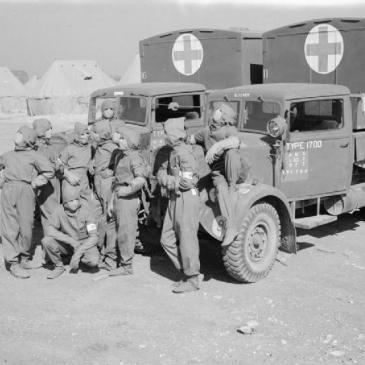
In fact, that act occurred just four days after Babe arrived in Casablanca. His time in Northern Africa was presumably in preparation for his move into Italy with the 34th Infantry — though the 34th was not part of the initial invasion force, according to the army pamphlet.

The U.S. 34th Infantry Division, a North Dakota National Guard unit commanded by Maj. Gen. Charles Ryder, the U.S. 3d Infantry Division, commanded by Maj. Gen. Lucian Truscott, and the U.S. 1st Armored Division, commanded by Maj. Gen. Ernest N. Harmon, would come ashore through Naples, which (Fifth Army commander Gen. Mark) Clark believed would be in Allied hands by D plus 13, or 23 September.

According to the introduction to the army’s account of the invasion: Read more of this post

Where Did Babe Fit Into the Mammoth Structure of the Military?

Antitank weapons (from World War II Infantry Anti-Tank Tactics, by Gordon L. Rottman)

Moving on, it will be helpful to know a little about how the army was structured during World War II. At this point, Babe has been assigned to the 34th Infantry Division, 168th Infantry Regiment. Shortly, he will be assigned to the Antitank Company within the 168th.

What does that mean?

According to About.com, Babe’s immediate community within the army would have consisted of anywhere from 62 to 190 soldiers. That’s the complement of an army company (Babe was in the antitank company).

Moving up the line, if I read the About.com article correctly, companies are assembled into brigades or regiments of between 3,000 to 5,000 soldiers (Babe was in the 168th Infantry Regiment). Three regiments make a division of between 10,000 and 15,000 soldiers (Babe was in the 34th Infantry Division).

Two to five divisions rolled up into a “corps” of 20,000 to 40,000 soldiers. Two or more corps combined to form an army of 50,000 or more soldiers. Babe was part of the Fifth Army (and I have the arm patch to prove it).

The function of an “antitank company” is probably self-evident, but I was curious to know a little more. I found “US infantryman in World War II.: European theater of operations, 1944-45,” By Robert S. Rush, Elizabeth Sharp, Ian Palmer, from 2002. The book included this description of an “antitank company.” Read more of this post

A Few Words about V-mail, a Precursor to Today’s Email

As I mentioned in the last post, Babe’s letter postmarked July 29, 1943, was his first to his parents on V-mail. I mentioned Dave Kent, editor of the Military Postal History Society Bulletin, in an earlier post. In my correspondence with him, he also mentioned V-mail.

“You might also run into an interesting World War II type of mail called ‘V-mail’ (as in ‘V for Victory’). V-mail letters were written on a special form and then photographed on microfilm. Only the film was sent back to the states, where it was developed and used to make a photographic copy of the original letter. These photograph letters were then mailed in a small envelope with a window in the front to show the address.”

The National Postal Museum website says a roll of the film contained about 1,700 messages weighed 5.5 ounces, compared to the 50 pounds a sack of the same mail would weigh.

About half the remaining letters from Babe will be on V-mail. The rest will be air mail.

The postal museum says that in its day, V-mail “played the same role 60 years ago that email is playing today in keeping lines of communication open between loved ones.” The museum’s web page on the subject of V-mail describes its origins:

Later to become “V-Mail” when adopted by the United States, the Airgraph Service was first developed by the British Post Office in response to the Italians closing of the Suez Canal and the Mediterranean Sea to Allied forces. Seaborne traffic was rerouted around the Cape of Good Hope. This 12,000 mile detour could mean delays of anywhere between three and six months for mail destined for British soldiers stationed in the Middle East and the Far East. Alternatives to the route around the Cape were considered, eventually settling on transport by aircraft-however, space in any aircraft was extremely limited. Microphotography was deemed the best solution to the problem of space.

The article says V-mail was in use by the U.S. military from June 15, 1942, until April 1, 1945, a little more than a month before Babe was killed. The postal museum said the first large-scale overseas V-mail processing center was opened right where Babe was located, in Casablanca, on April 15, 1943, about three months before he got there.

Getting to Know Babe’s Whereabouts When He Landed in North Africa

Piecing together the life of a soldier from his letters is substantially more difficult than I expected. I just don’t have access to the information, or the time it might take to find it. With what I have to work with, I am learning that I do little more than speculate.

For example, I’ve noticed that in Babe’s first few letters from North Africa, his return address changes three times. The first two may be the same, but rendered differently, but he moves from the “2nd Replacement Depot” to the “1st Replacement Depot” from one letter to the next.

A “replacement depot” was apparently a holding tank, essentially, for soldiers who came overseas and before they were assigned to a permanent unit. They were literally what they sound like: A holding depot for replacement soldiers. They were to replace the soldiers who were killed, captured or wounded.

One article on the subject of replacement depots doesn’t paint them in a very favorable light, calling the troops staged there “military orphans with little esprit de corps and no cohesion.” Read more of this post

Learning More About Tracking Army Post Office Movements

From my earlier post, written by Dave Kent of the Military Postal History Society, I learned that Army Post Office numbers, or APOs, are an effective means of tracking the location of a military unit. I expect to learn more going forward about how specific that information will become.

I recently corresponded with Richard V. Horrell, who runs WW 2 Connections and lists his home in Nashville. His website says he uses his passion for World War II history to create profiles of military personnel that he “researches and creates for his clients. His clients share with him the desire to remember what these men and women did for us 60 years ago.” I came across him through AllExperts.com.

Horrell responded to my questions about how to track APO numbers, which appear in the return address of all Babe’s letters. He responded on one of the APO numbers, but I realized Babe’s APO changes a few times, so I went looking for a source. I stumbled on this blog post from someone doing genealogical research, with a link to a PDF called “Numerical Listing of APOs, January 1942 to November 1947. It seemed like what I was looking for. I have it available on my site here.  (While trying to validate its authenticity, I found it apparently listed in a Smithsonian Institution index). Read more of this post